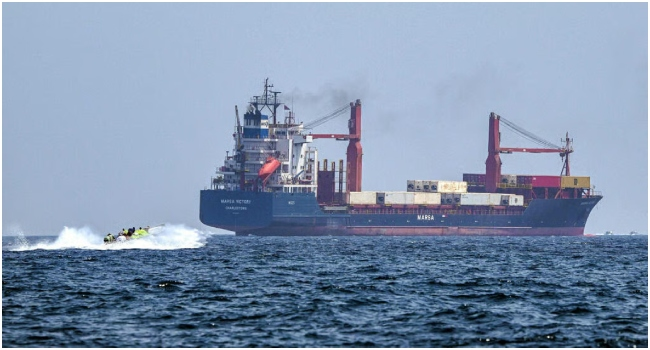
The United States military has declared that Iran’s ability to threaten maritime traffic in the Strait of Hormuz has been significantly weakened, following a series of coordinated air and naval strikes targeting key Iranian military infrastructure.

This development marks a critical turning point in the ongoing Middle East conflict, as global markets and governments closely monitor the security of one of the world’s most important oil transit routes.
According to senior U.S. military officials, recent operations have successfully degraded Iran’s offensive capabilities, particularly those used to target ships and disrupt navigation in the Strait of Hormuz.
Admiral Brad Cooper, head of U.S. Central Command, revealed that thousands of military targets have been struck, including missile systems, radar installations, and naval assets. These strikes are part of a broader effort to neutralize Iran’s ability to interfere with global shipping lanes.
Recent reports indicate that a major underground facility along Iran’s coastline—used for storing anti-ship missiles and monitoring maritime activity—was destroyed using high-impact airstrikes. This has reduced Iran’s capacity to track and attack vessels in the region.
The Strait of Hormuz is one of the most strategically important waterways in the world. Roughly 20% of global oil supply passes through this narrow channel connecting the Persian Gulf to international markets.
Since the conflict began, shipping activity in the strait has slowed significantly, contributing to volatility in global energy markets.
The U.S. and its allies have ramped up military operations in recent weeks, focusing heavily on Iran’s naval and missile infrastructure.
One notable operation involved large-scale strikes on Iran’s Kharg Island, a crucial hub for military logistics and oil export infrastructure. These strikes reportedly destroyed dozens of military sites linked to Iran’s ability to control the Strait of Hormuz.
Despite these efforts, U.S. officials acknowledge that operations are ongoing, and the situation remains fluid.
While the U.S. claims progress, Iran has continued to launch retaliatory attacks, including missile strikes targeting U.S. and allied bases in the region.
In one recent incident, Iran fired long-range ballistic missiles toward a joint U.S.-UK base, signaling that it still retains the capability to project force beyond its borders.
Iran has also maintained pressure on maritime routes, with threats to shipping and continued attempts to disrupt navigation in the Gulf.
The escalating conflict has drawn widespread international concern. Countries around the world have called for de-escalation, warning that prolonged instability in the region could have severe economic and geopolitical consequences.
The United Kingdom has even authorized the use of its military bases to support U.S. operations targeting Iranian missile sites threatening the strait—highlighting the growing international dimension of the conflict.
Meanwhile, global oil markets remain highly sensitive, with prices fluctuating as uncertainty persists.
Although the U.S. military insists that Iran’s threat to the Strait of Hormuz has been significantly reduced, analysts caution that:
Even U.S. officials have previously acknowledged that fully securing the waterway is a complex task, requiring sustained military presence and coordination.
As the conflict enters a critical phase, attention is now shifting toward whether the U.S. can fully reopen and secure the Strait of Hormuz for global shipping.
For now, the U.S. maintains that its operations are achieving their weakening Iran’s ability to threaten one of the world’s most vital economic lifelines.
The claim that Iran’s threat to the Strait of Hormuz has been “degraded” reflects significant military progress by the United States. However, the broader conflict remains far from resolved.
With both sides continuing to exchange strikes and global stakes at an all-time high, the situation in the Gulf remains one of the most critical geopolitical flashpoints in the world today.
Leave a Reply