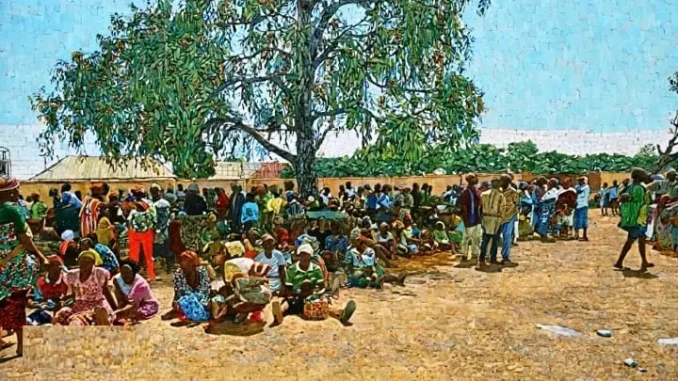
The first light of day in Benue’s displacement camps doesn’t bring comfort—it reveals survival.
Before sunrise, movement begins. Not the purposeful activity of a thriving village, but the slow, weary motions of people adjusting to a life they never chose. Fires struggle to stay lit under damp wood. Infants cry in fragile shelters patched together with tarpaulin and worn-out fabric. Children wander toward informal classrooms beneath trees, uncertain if anyone will come to teach them that day.
This is not a temporary crisis anymore. It has become a way of life.
Across Nigeria, millions of people have been forced out of their homes by conflict and violence. In Benue State alone, vast numbers of families remain trapped in camps that were never designed for long-term living. What began as an emergency response has stretched into years of uncertainty, neglect, and fading hope.
Each tent in these camps tells a deeper story. Entire communities have vanished overnight. Farms once rich with crops now lie abandoned. Generations of farmers have been reduced to waiting—for aid, for safety, for answers.
Benue has long been celebrated as Nigeria’s agricultural heartbeat. Its fertile lands fed not just the state, but much of the nation. Farming here wasn’t just a livelihood—it was culture, pride, and identity.
In one of the camps, a man named Terdoo reflects on a life that no longer exists. His voice carries both memory and loss.
There was a time when his days began before dawn—not out of desperation, but out of dedication to the land. Farming was a skill refined over years, guided by experience and instinct. He understood the soil, the seasons, the rhythm of nature.
Food was never a constant worry. Hunger, when it came, was temporary. His barns were filled with yams, his maize dried safely in the open, and his children never had to wait for their next meal.
Today, Terdoo and thousands like him rely on aid for survival. The independence they once knew has been replaced by uncertainty. The land they cultivated with pride is out of reach, and the skills they mastered have little use within the confines of a camp.
The psychological toll is just as heavy as the physical hardship. Parents struggle to explain to their children why they cannot return home. Young people grow up disconnected from the lives their families once lived.
Among displaced communities, one sentiment is becoming louder: honesty is needed.
Many IDPs are no longer asking for promises—they are asking for clarity. If returning home is not possible in the near future, they want to know. If there is a plan, they want to see it. The uncertainty, they say, is more painful than the truth.
“Stop pretending,” one displaced resident expressed. “If we can’t go back, just tell us.”
It’s a statement born not out of anger alone, but exhaustion.
The situation in Benue reflects a wider national challenge. Displacement on this scale is not just a humanitarian issue—it is an economic, social, and security crisis. When farmers are driven from their land, food production suffers. When communities are uprooted, entire local economies collapse.
And when people lose their sense of belonging, the impact lingers for generations.
The future of Benue’s displaced population hangs in the balance. What they need goes beyond temporary relief—it requires lasting solutions. Security must be restored. Homes must be rebuilt. Livelihoods must be revived.
Because for many in these camps, the real loss isn’t just land or property—it’s the life they once knew, and the belief that they will ever return to it.
Until that changes, every sunrise in the camps will look the same: a new day, carrying the weight of an old struggle.
Leave a Reply