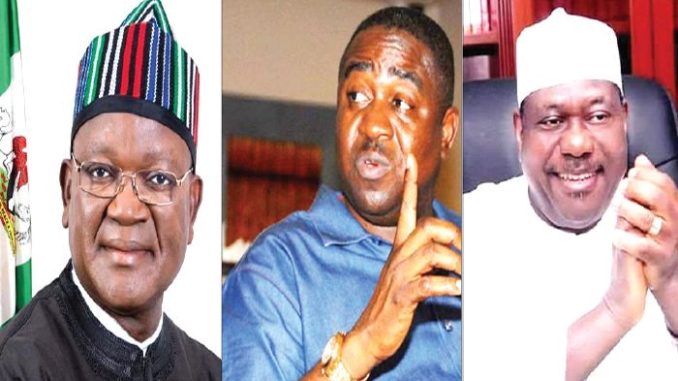
Politics in Benue State has long followed a predictable script whenever a governor seeks a second term. Since Nigeria’s return to democracy in 1999, the pattern has been clear—power struggles intensify, alliances shift, and opposition forces regroup with renewed energy.
George Akume, Gabriel Suswam and Samuel Ortom.From the days of George Akume to Gabriel Suswam and later Samuel Ortom, second-term ambitions have always attracted resistance. Interestingly, many of these battles were not driven by strong political ideologies, but by the desire to control influence and remain relevant in the state’s power structure.
As each administration approached reelection, old rivals often became new allies. Political camps merged, not necessarily out of shared vision, but out of shared interests. This created a tense environment where accusations, counter-accusations, and strategic moves dominated the scene.
In some cases, the tension went beyond words. Reports of intimidation and political pressure became part of the story. Yet, despite all this, incumbents who managed to retain public support and maintain strong ties at the federal level usually emerged victorious.
Today, Hyacinth Alia appears to be walking the same path. As conversations around his second term begin to grow, familiar political patterns are reappearing.
New alliances are forming once again, and critics are raising concerns about governance—especially around insecurity. While security challenges in Benue are real, many analysts argue that the issue is not unique to the state but reflects a wider national problem.
Governor Alia has openly supported the idea of state policing, aligning with broader discussions led by Bola Ahmed Tinubu on improving Nigeria’s security system. This suggests an effort to focus on long-term solutions rather than quick fixes.
One major concern is the growing claim that insecurity is being used as a political tool. Some observers believe that certain groups are amplifying fears and spreading unverified information to weaken the current administration. However, these criticisms often lack clear alternatives or practical solutions.
There are also ongoing rumors about a possible rift between Governor Alia and key federal figures, including George Akume and President Tinubu. So far, these claims remain unproven, raising doubts about their credibility.
What is happening in Benue today is not entirely new. It reflects a deeper issue in Nigerian politics, where power struggles often overshadow policy discussions. As the state moves closer to another election cycle, the key question remains: will the focus stay on political battles, or shift toward real solutions for the people?
For now, Benue stands at a familiar crossroads—one shaped by history, but still open to change.
Leave a Reply