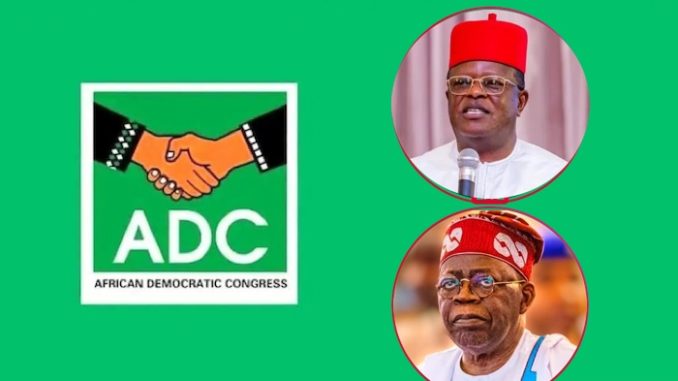
The Enugu State chapter of the African Democratic Congress (ADC) has strongly rejected recent comments made by Nigeria’s Minister of Works, David Umahi, regarding the political stance of the South-East ahead of future national elections.
Umahi had reportedly claimed that the people of the South-East region were fully aligned with the administration of President Bola Ahmed Tinubu and would continue supporting the ruling All Progressives Congress (APC). However, the ADC in Enugu described the statement as misleading, insisting that the minister lacked the authority to speak on behalf of the entire region.
In a statement released by party leaders in Enugu, the ADC argued that political opinions across the South-East remain diverse and cannot be reduced to a single viewpoint. According to the party, many residents in the region are still dissatisfied with the current economic and security situation in the country.
The opposition party maintained that support for any political party must be earned through good governance, fairness, and policies that directly improve the lives of ordinary Nigerians. The ADC noted that hardship, rising inflation, unemployment, and insecurity continue to affect citizens across the South-East and other parts of the country.
Party officials further emphasized that no individual politician should assume the authority to determine the political direction of millions of people without proper consultation or democratic engagement.
The ADC also condemned what it described as indirect threats allegedly connected to federal infrastructure projects in the South-East. According to the party, some political comments surrounding ongoing projects have created the impression that federal developments in the region may depend on political loyalty to the ruling party.
The party warned against using public projects as political bargaining tools, stressing that infrastructure development is a constitutional responsibility of the federal government and not a reward for political support.
ADC leaders argued that roads, bridges, and other federal projects are funded with taxpayers’ money contributed by Nigerians from all regions. Therefore, they said no community should feel pressured to support a particular political party in exchange for development.
The disagreement highlights the growing political tension in the South-East as parties begin positioning themselves ahead of future elections. The region has historically been a stronghold for opposition parties, although recent political alignments have shown increasing competition among major parties.
Observers believe the debate reflects broader concerns about representation, inclusion, and the relationship between the federal government and the South-East region. Many political stakeholders continue to call for more balanced national development and greater attention to issues affecting the area.
The ADC reiterated that democracy allows citizens the freedom to support any political party of their choice without intimidation or pressure. The party also encouraged voters to focus on accountability, leadership performance, and policies rather than political rhetoric.
Umahi’s comments and the ADC’s response have sparked reactions among political observers and citizens across Nigeria. While supporters of the APC argue that the current administration is investing heavily in infrastructure across the South-East, critics insist that development projects should not be politicized.
Analysts say the exchange may further intensify political discussions within the region as parties attempt to strengthen their influence before the next electoral cycle.
For many residents, however, the primary concerns remain economic stability, improved security, job creation, and better living conditions. Political parties seeking support in the South-East are likely to face increasing pressure to provide practical solutions to these challenges rather than relying solely on political declarations.
As the debate continues, Nigerians across different regions will be watching closely to see how political leaders address concerns surrounding governance, inclusion, and national unity in the months ahead.
Leave a Reply